
Author
Board of 2025-26
Board of 2025-26
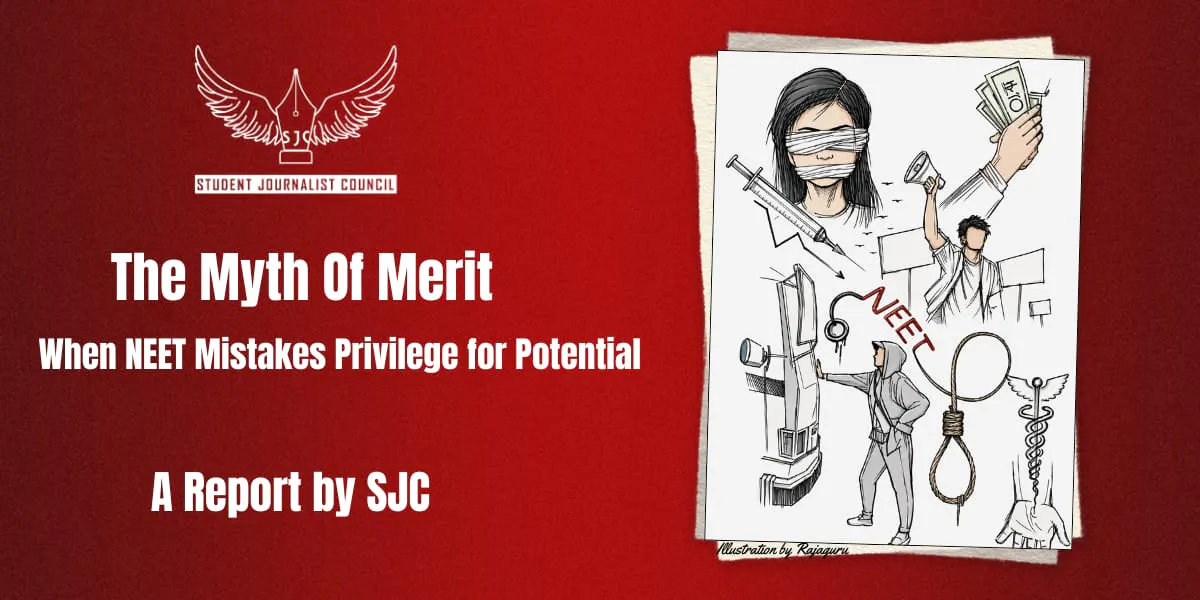
There was a little ball of sunshine in a village in Ariyalur, Tamil Nadu. Her name was S. Anitha. She lost her mother when she was young. Her father was a daily-wage laborer, the sole breadwinner of the family. She came from a world where becoming a doctor was not an inherited expectation but an almost audacious dream. Yet she. She scored 1,176 out of 1,200 in her Class XII Tamil Nadu State Board examination, securing a medical cut-off of 196.75 out of 200. She wanted to become a doctor because she knew what the absence of one could mean to a village like hers. She wanted to become a first-generation doctor and return to the people she came from. Then came NEET.
In 2017, Anitha scored 86 out of 720 in the National Eligibility-cum-Entrance Test. The girl who had excelled in her school examination suddenly appeared, through the arithmetic of one national test, to be nowhere near good enough for medicine. She had fought against the implementation of NEET and had even approached the Supreme Court. On September 1, 2017, she died by suicide. Her death cannot responsibly be explained by an examination alone; a human life is never reducible to a score. But neither can we erase the fact that the medical seat she had spent years dreaming about had become dependent on a system she believed was stacked against students like her. And that is where the uncomfortable question begins.
What exactly do we mean when we say merit?
We speak about merit as if it were something pure, something that exists independently inside a student and can be extracted neatly through an examination. We put a number beside a name and call it ability. We put another number beside another name and call it failure. But a mark sheet cannot tell the story behind the number. It cannot tell us what kind of educational world produced it. The number is visible. The privilege behind the number is not.
NEET was built around an idea that sounds almost impossible to oppose: uniformity. One country, one examination, one standard. The argument was that a common entrance test could replace a fragmented system and make medical admissions more transparent and comparable. But there is a difference between making the examination uniform and making the opportunity uniform.
India is not a uniform educational landscape. A student from an affluent urban school and a student from a rural government school may sit for the same examination, but they do not necessarily arrive there carrying the same preparation. One may have spent two years inside a specialized coaching ecosystem. Another may have spent those two years trying to master a state-board syllabus that does not map perfectly onto the competitive examination. The question paper cannot see that difference.
Should the system be allowed to ignore it?
The National Medical Journal of India itself questioned whether NEET had actually delivered the uniformity promised by its introduction. It pointed to differences between state-board syllabi and the NEET syllabus and questioned whether merely translating a common question paper into different languages could create genuine equivalence between students educated in very different systems. This is the first crack in the mythology of merit. A child who has never had access to the same educational resources as another child is asked to compete with that child, and when the results arrive, we call the difference in their scores a difference in merit.
But what if it is partly a difference in opportunity?
This is where coaching enters the story. NEET was supposed to be an examination. It has increasingly become an ecosystem. Coaching centres have built an enormous industry around teaching students not simply biology, physics and chemistry, but how to beat the examination itself. The longer the competition becomes, the more valuable specialized preparation becomes. And the more valuable specialized preparation becomes, the more it becomes something families with money can purchase. The rich do not buy intelligence. They buy preparation. They buy test series. They buy specialized study material. They buy private teachers. They buy repeated mock examinations. They buy a quiet room. They buy time. They can sometimes buy another year of preparation without worrying about whether the family can survive it financially. A poor student cannot necessarily buy any of those things. And yet both answer sheets eventually arrive at the same evaluator.
The irony is brutal: the examination does not charge different prices for its question paper, but the preparation required to compete successfully against it is not equally affordable. The NMJI has also raised concerns about the growing dependence on coaching and the way competitive examinations can shift the centre of education away from schools themselves. That creates another casualty: school education itself.
When a student's medical future depends overwhelmingly on NEET, Class XI and XII can stop being years of education and become years of preparation. The classroom becomes the place where attendance happens. The coaching centre becomes the place where the real examination is supposedly taught.
What happens to a system when children begin believing that school is secondary and the coaching institute is their actual education? We tell students to understand concepts, to explore science, to learn because knowledge matters. Then we give them an examination in which a fraction of a mark can change their medical college, their rank, their year, sometimes the entire direction of their life. We have turned learning into a race against the clock and then wondered why students are exhausted. There is also a deeper problem with the argument that NEET necessarily produces better medical students.
A common examination can rank students very efficiently. But ranking efficiently is not the same as measuring everything that makes a good doctor. Medicine requires scientific knowledge, certainly. It requires discipline, memory, reasoning and the ability to learn enormous amounts of information. But it also requires communication, empathy, judgment, resilience and an ability to understand human beings. A three-hour examination cannot measure all of that. And even within academic ability, a score tells us how someone performed on that examination not the complete extent of what that person is capable of becoming.
The NMJI article goes further, questioning whether NEET actually delivered the improvement in quality that was used to justify its introduction. It pointed out the striking disconnect between very high school-board performance and very low NEET performance among some state-board students, raising questions about whether the examination was testing knowledge or, in part, familiarity with a particular curriculum and examination structure. That brings us to language. India likes to say that NEET is available in multiple Indian languages, as though translation itself solves the problem. It does not. Translating a question is not the same as translating an educational ecosystem. A Tamil-medium student does not suddenly receive the same preparation as a CBSE student because the English question has been translated into Tamil. The textbook, the sequence in which concepts are taught, the depth, the examination culture, the teacher training and the resources may differ. And yet, at the end, we place both students beneath the same national measuring scale.
The NMJI made precisely this point: language availability alone does not establish equivalence when the underlying syllabi and educational experiences are different. This is why Anitha's story still matters. Not because her 1,176 marks automatically meant she deserved an MBBS seat. That would be too simplistic. It matters because her results exposed a contradiction we still struggle to confront: how can a student perform exceptionally within the education system she was given and then be judged as though that education never existed?
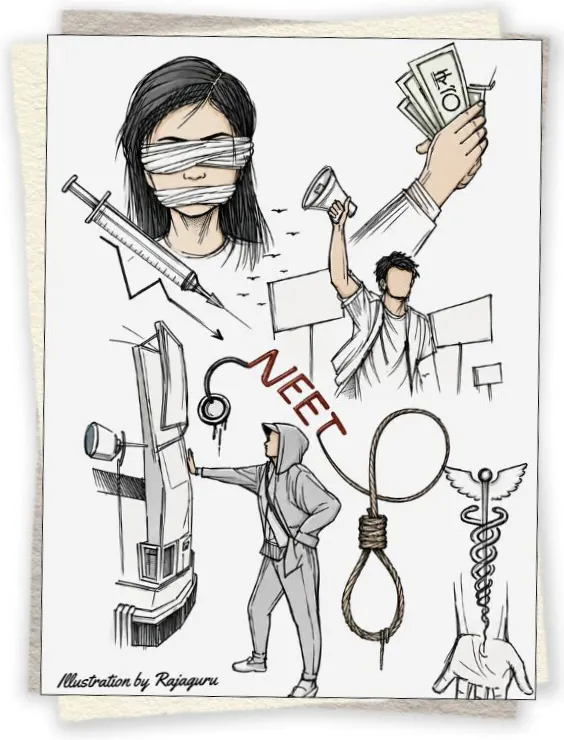
.
Her board marks were not proof that she would necessarily have become a brilliant doctor. Her NEET score was not proof that she could never have become one. Both were measurements. The mistake was treating one measurement as though it contained the entire truth about her ability. And then there is the issue of trust. An examination as consequential as NEET requires more than a secure question paper. It requires public faith that the rules are stable, the process is transparent, the paper is protected, mistakes are acknowledged and corrected, and every student is competing under genuinely comparable conditions. The controversies surrounding NEET in recent years—including allegations of paper leaks, irregularities, grace marks and disputes over results—have damaged that trust. The problem with an examination scandal is not merely that some students may have received an unfair advantage. It is that every honest student's achievement becomes surrounded by suspicion.
The student who spent two years studying cannot know whether the person above her studied harder or had access to something she did not. And when that uncertainty enters an examination, merit itself begins to lose its authority. A national examination asks students to trust the institution behind it with their futures. That trust is not a luxury. It is the foundation of the examination. And perhaps nowhere is the cost of this system more visible than in the mental health crisis surrounding high-stakes entrance examinations.
Every year, teenagers are asked to compress an enormous amount of science into a few hours and then attach their entire future to the result. Students take drop years. Some take multiple attempts. Families invest their savings. Friendships disappear into study schedules. Sleep becomes negotiable. Failure becomes shame. The frightening part is not simply that students are stressed. It is that we have normalized the stress. We call sleeplessness dedication. We call burnout discipline. We call anxiety competition. We tell an eighteen-year-old that another year of life is nothing compared with a medical seat. And when the student break under the pressure, we ask why they were not strong enough. Perhaps the question should sometimes be why the system demanded so much strength from a child in the first place. I know what that number feels like. I was a NEET aspirant too. I scored 586 out of 720. I missed the seat I wanted by four marks. Four. To someone outside the system, 586 may sound like an excellent score. But NEET does not ask whether your score is good in isolation. It asks where your score places you in an enormous queue for a limited number of seats. Four marks can separate a government medical seat from another year of preparation. Four marks can separate a dream from a compromise. And when the alternative is private medical education costing around ₹1 crore, the question stops being purely academic. A crore is not just a number. For an ordinary family, it can represent decades of savings. It can represent a house. It can represent parents' retirement. It can represent another child's education. It can represent financial security. I could not look at that price and call it an opportunity. I could not ask my family to mortgage its future so that I could pursue mine. So I walked away. And that experience changed the way I look at the word merit.
Because if two students are equally capable but only one can afford another attempt, another year of coaching or another route through private education, are we really measuring merit or are we measuring who can remain in the race for the longest? This is where we need to distinguish between equality and equity. Equality says: give everyone the same examination. Equity asks: what did everyone have to overcome to reach that examination? Those are not the same question. Giving a rural student the same question paper as an urban student is equality. Giving that rural student access to good teachers, laboratories, reliable electricity, digital resources, quality textbooks, mentoring and affordable preparation is equity. We have become very proud of the first. We have not done nearly enough of the second. And this is not an argument for lowering medical standards.
India needs competent doctors. It needs rigorous medical education. It needs students who genuinely understand science. It needs a system capable of identifying academic ability. But a rigorous standard does not require us to pretend that the country is socially and educationally uniform. India is diverse. Our examination system should be capable of recognising that diversity rather than erasing it. The tragedy is that we often talk about NEET as though there are only two camps: people who believe in merit and people who oppose merit. That is a false choice. I believe in merit. I believe students should work hard. I believe medical education should be demanding. I believe doctors should meet high academic standards. What I do not believe is that a single score, produced after years of unequal educational opportunity, should be treated as a perfect and unquestionable representation of human potential.
Because merit does not grow in empty soil. It needs teachers, books, time, electricity, nutrition, language access, money—or, at the very least, a system capable of compensating for its absence. We cannot plant two seeds in completely different soil, give one water every day and leave the other fighting the heat, then point at the taller plant and declare: “This one had more potential.” That is not how potential works. And that is why Anitha's story should not be remembered merely as the story of a girl who scored 86. It should be remembered as the story of a girl who scored 1,176 in the education system available to her, who came from a family that could not purchase the preparation others could, who challenged a national examination because she believed it disadvantaged students like her, and who became a symbol of the enormous distance between equality on paper and fairness in real life. Her death should not become a political slogan. It should become a question. A question we should ask every time we celebrate a rank and dismiss a failure: Did we measure merit or did we measure the resources that made merit easier to display? Because a country does not become fair merely by putting everyone in the same examination hall.
A country becomes fair when a child's birthplace does not quietly decide how much of her potential the examination is capable of seeing. NEET promised one standard. But India has never had one starting line. And until we fix that, calling the race fair is simply another way of refusing to look at who was allowed to run.
Credits:
Patron: Dr. K. Manonmani, Principal of GCT
Staff In-charge: Dr. M. Kalpana
Editor in Chief: Mathimalar V (IT 23-27)
Article prepared by: Mathimalar V (IT 23-27)
DISCLAIMER: The opinions or views expressed are views of the individual writers and not of the institution. All forms of content published in this website and Student Journalist Council - GCT's social media handles are strictly properties of Student Journalist Council - GCT and are works of the various teams of the respective academic years.
No article, story or any form of content produced by Student Journalist Council - GCT is meant to be reproduced or distributed, either in parts or whole, without prior permission from Student Journalist Council - GCT for any purposes.


